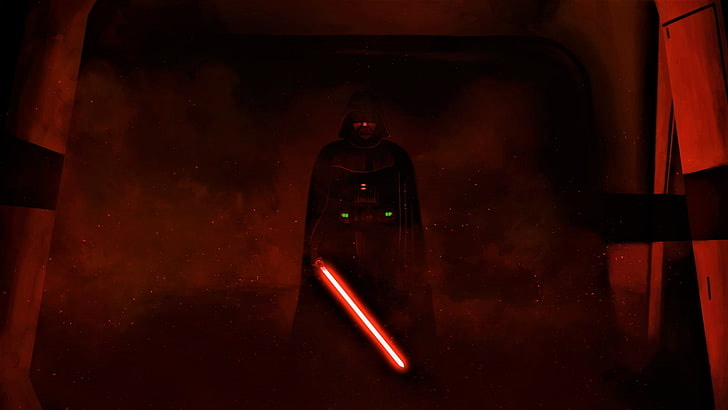
There’s a particular kind of silence that comes with watching Star Wars for the first time.
Maybe you were a kid, sitting too close to the television, the room dim except for the glow of hyperspace streaking across the screen. Maybe it was a worn VHS, or a late-night cable rerun, or a theatrical re-release your parents insisted mattered. However you found it, the feeling was the same: the sense that you were stepping into a universe already in motion. That these people had lived full lives before you met them. That history existed just out of frame. And for that moment, which had magically lasted for years to come, Star Wars felt infinite.
As children we didn’t need consistency. We didn’t ask where governments came from or what happened after the celebration. The myth was enough. The imagery carried us. Laser swords hummed, powers were wizardly and mysterious, the galaxy felt old and dangerous and impossibly large. And then, suddenly, we grew up. We learned how stories work. We learned to notice when tone shifts between installments, when consequences dissolve, when political stakes are introduced and then abandoned. We started asking questions the saga never intended to answer and realized, slowly, that it wasn’t going to mature with us.
Star Wars kept returning to the same emotional register. It kept resetting the board. Empires fell and reappeared. Characters died and returned. Victories felt symbolic rather than structural. The galaxy remained a backdrop for destiny rather than a system shaped by decisions. What once felt mythic began to feel evasive, and the problem was never imagination. It was follow-through, a problem A Gambit of Exiles understands instinctively.
Like Star Wars, it is set in space. It features laser-sword wielding telekinetics, ancient orders, and galaxy-spanning conflict. On the surface the ingredients are familiar enough to feel comforting, but where Star Wars relies on nostalgia and archetype, A Gambit of Exiles fully commits to consequence.
The story does not begin tittering at the edge of true conflict, it begins inside it. The galaxy is already fractured. Alliances are already strained. Loyalties are inherited rather than chosen. There is no illusion of a clean slate, no promise that heroism will restore balance. This immediate division creates immersion not through exposition, but through pressure. You don’t learn the rules because they’re explained, you learn them because characters suffer when they’re broken. Power in A Gambit of Exiles is treated the way medieval power was treated: as personal, political, and dangerously unstable. Telekinetic warriors are not mythic saviors operating above consequence; they are embedded within institutions that fear them, exploit them, and hunt them when necessary. Strength invites surveillance. Visibility invites death.
And looming over everything is Dawnfall. Unlike the recurring superweapons and resurrected villains that plague Star Wars, Dawnfall is not an antagonist but a phenomenon. A natural, unpredictable collapse in which the sun loses its heat, plunges into dormancy, and freezes entire regions of the galaxy. Its arrival awakens the undead horrors of The Wake who do not conquer, negotiate, or rule.
Dawnfall cannot be defeated in a final act. It cannot be redeemed. It does not wait for character arcs to resolve. It forces the galaxy to reckon with extinction as a logistical problem rather than a moral one. Politics do not pause in the face of apocalypse, they intensify. Alliances fracture. Sacrifices become permanent. Survival demands choices that cannot be walked back. And this is where A Gambit of Exiles succeeds where Star Wars so often retreats. It commits to tone. It commits to consequence. And crucially, it commits to aftermath. Victories leave scars. Losses reshape power structures. Resolutions do not erase repercussion. The prose itself reinforces this discipline—cinematic, deliberate, and grounded, allowing each scene to unfold visually while refusing to romanticize violence or absolve decision-making.
A Gambit of Exiles does not try to recapture the feeling of watching Star Wars for the first time. It accepts that you are no longer that person. Instead, it offers something rarer: a space epic that grows up with its audience. One that understands that wonder does not disappear with age but deepens when paired with accountability.
The Star Wars problem isn’t that the galaxy became too big. It’s that it never learned how to live with what it broke. A Gambit of Exiles starts there.
 The Vacancy
Leave a comment