If you were watching anime around 2011, you remember the feeling.
This was an era defined by atmosphere as much as action. By glossy openings, swelling soundtracks, and stories that took their time letting dread seep in. Titles like Steins;Gate, Future Diary, Deadman Wonderland, and Psycho-Pass were less interested in comfort than in tension. Worlds felt unstable. Protagonists were often overwhelmed rather than empowered. The future was never clean, and survival rarely came without compromise. It was in that moment that quietly, almost unassumingly, Guilty Crown arrived.
Often remembered more for its music and aesthetics than its narrative ambition, Guilty Crown has spent years mislabeled as style over substance. But revisited now under a different lens, removed from the expectations of weekly hype and genre comparison, it reveals itself as something far more chilling and deliberate: a dystopian tragedy about power, fear, and the seductive logic of control.
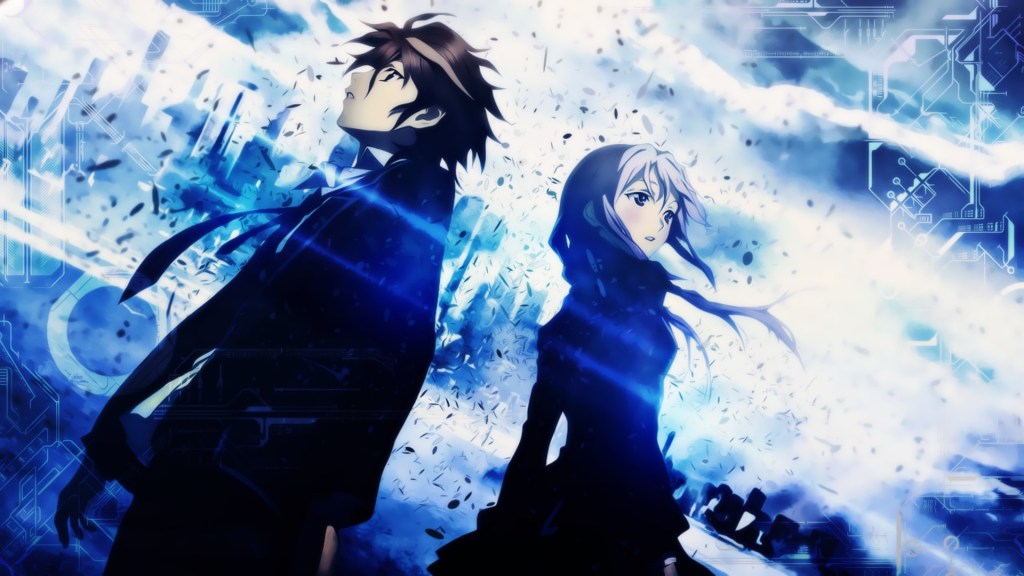
Set in a near-future Japan quarantined after a viral apocalypse known as the Lost Christmas incident, Guilty Crown presents a society already accustomed to surrendering freedom in exchange for safety. Foreign military forces maintain order. Civil liberties are conditional. Surveillance is normalized. The world does not collapse overnight but instead hardens slowly and bureaucratically until authoritarianism feels reasonable, and at the center of this world is Shu Ouma, a painfully ordinary teenager whose defining trait is avoidance. Shu does not want responsibility. He wants invisibility. And that reluctance is precisely what makes Guilty Crown effective. Unlike many protagonists of its era, Shu is not built for heroism; he is shaped by fear, isolation, and a desperate desire to belong.
That changes when Shu gains the Power of Kings: the ability to extract manifestations of a person’s soul (called Voids) and wield them as weapons, each Void reflecting the owner’s psyche: shields, blades, tools of defense or destruction. Power in Guilty Crown is not abstract but intimate. To fight, Shu must reach into the people closest to him, literally weaponizing their inner selves, resulting in the understanding that dystopia is not about ruined cities or totalitarian uniforms. It’s about what happens when survival logic overrides empathy. As pressure mounts and fear escalates, Shu’s leadership evolves into something colder, more efficient, and deeply unsettling. In one of the series’ most infamous and hyped arcs, he imposes a rigid hierarchy among his peers, ranking them by usefulness and assigning value based on their Voids.
People are no longer classmates. They are assets. And the brilliance of this moment lies in how reasonable it feels. Shu’s descent is not framed as madness but as pragmatism. Scarcity demands structure. Threats demand control. Emotional distance becomes a strategy. What begins as protection curdles into authoritarianism, and the show refuses to let the audience pretend otherwise. This is Guilty Crown at its strongest: exposing how easily morality erodes when efficiency becomes the highest virtue. The series does not ask whether Shu is right or wrong, it asks whether the system he builds is inevitable. And more importantly, whether the audience would have done anything differently under the same conditions.
Combined with its stark visual identity, haunting score, and willingness to let characters fracture under pressure, Guilty Crown becomes something rare: a dystopia that understands the emotional cost of leadership. Not everyone breaks heroically. Some people break quietly and take others with them.
Overshadowed in its time by louder, more immediately gratifying titles, Guilty Crown has aged into clarity. What once felt uneven now reads as intentionally uncomfortable. Its messiness mirrors the chaos of power itself. In revisiting it, one thing becomes clear: it was never trying to be the most popular dystopian anime of its era. It was trying to be the most honest.
And for those willing to look past its reputation, it remains one of anime’s most unsettling—and overlooked—visions of what happens when fear is allowed to govern.
 The Vacancy
Leave a comment